
The best retaining wall material for a Victoria BC property depends on wall height, soil conditions, drainage requirements, and budget. Concrete block systems like Allan Block and Redi-Rock perform best for structural walls over one metre, while natural boulder and gabion systems offer superior drainage and a natural West Coast aesthetic for residential landscapes.
Victoria BC’s coastal climate, classified as Csb under the Köppen system, creates specific demands for any retaining wall contractor. Annual rainfall exceeding 600 millimetres, concentrated between October and March, means that drainage design and material durability are the two most critical factors in retaining wall longevity across Greater Victoria.
Why Material Selection Determines How Long a Retaining Wall Lasts
A retaining wall fails for one of two reasons: inadequate base preparation or insufficient drainage behind the wall. Material selection directly affects both. Permeable materials like gabion baskets and boulder systems allow water to pass through naturally, reducing hydrostatic pressure. Impermeable materials like poured concrete require engineered drainage systems including perforated drain pipe, free-draining gravel backfill, and weep holes to achieve the same result.
In Victoria’s clay-heavy soils, found particularly in Saanich, View Royal, and parts of Langford, water retention behind a poorly drained wall creates lateral pressure that causes leaning, cracking, and eventual structural failure. A retaining wall contractor in Victoria BC who understands local soil profiles and drainage patterns will specify the right material and drainage solution from the design stage.
Concrete Block Retaining Walls: Allan Block and Redi-Rock Systems
Concrete block retaining walls, particularly those using the Allan Block system, are the most widely used structural solution for residential retaining walls in Victoria BC. Allan Block is a professionally certified modular concrete block system engineered for interlocking dry-stack construction without mortar in most residential applications.
Allan Block walls are suited to garden terraces, driveway support walls, slope stabilization, and tiered yard designs where a clean, structured appearance is required. The system accommodates curves, corners, steps, and caps, giving retaining wall contractors in Victoria BC the flexibility to match diverse property configurations.
Redi-Rock is a large-format precast concrete block system that combines the mass and strength of engineered concrete with the visual appearance of natural stone. It is typically specified for taller structural walls, commercial retaining projects, and properties with significant grade changes where smaller modular block systems would require extensive geogrid reinforcement.
Both systems comply with BC Building Code requirements and can be engineered to meet permit specifications for walls exceeding one metre in height under City of Victoria and Capital Regional District regulations.
For homeowners considering a concrete block retaining wall, view our retaining wall and landscaping services in Victoria BC to understand how these systems are specified for local soil and drainage conditions.
Natural Boulder and Stone Retaining Walls: The West Coast Standard
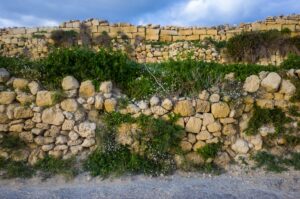
Natural boulder retaining walls are one of the most effective and visually appropriate solutions for Victoria BC properties. Large fieldstone boulders and quarried granite or basalt create a gravity-based wall system that relies on mass and interlocking placement rather than engineered connections or mortar.
Boulder walls are particularly well suited to Victoria’s residential landscapes because they complement the natural West Coast aesthetic common in Oak Bay, Saanich, and Langford. The irregular surfaces and natural colour variation of fieldstone integrate with planted garden beds, mature trees, and natural stone pathways in a way that manufactured block systems cannot replicate.
From a structural standpoint, boulder retaining walls perform well in Victoria’s wet climate because gaps between stones allow water to drain freely, eliminating the hydrostatic pressure that causes rigid walls to fail. A skilled retaining wall contractor in Victoria BC selects and places boulders based on weight distribution, wall batter (backward lean), and drainage characteristics rather than simply stacking for appearance.
Natural stone veneers and mortared blast rock are also used in Victoria BC retaining walls where a more refined finish is required, for example on visible street-facing walls or formal garden designs in Fairfield and Rockland where heritage character properties require material-appropriate hardscape.
Gabion Retaining Walls: Engineered Drainage for Victoria’s Rainfall
Gabion retaining walls use galvanized or PVC-coated steel wire baskets filled with rock, stone, or recycled concrete aggregate. The primary structural advantage of gabion systems is their inherent permeability. Water passes through the rock-filled baskets freely, making gabion walls one of the most drainage-efficient retaining solutions available for Victoria BC’s high-rainfall environment.
Gabion walls are specified by retaining wall contractors in Victoria BC for erosion control on steep slopes, waterfront properties subject to wave action or tidal flooding, and drainage-problem sites where conventional walls would require complex engineered drainage systems. The wire baskets conform to the site topography and can be stacked to create curved or terraced configurations.
The modern industrial aesthetic of gabion walls has also made them a popular design choice for contemporary residential landscapes in Greater Victoria, particularly for projects that combine retaining function with landscape feature design.
Timber Retaining Walls: Cost-Effective for Lower Walls
Pressure-treated timber retaining walls, typically using 200×200 millimetre or 150×200 millimetre landscape timbers or posts and planks, remain a cost-effective option for lower residential retaining walls in Victoria BC. Timber is suited to garden bed edges, terraced vegetable garden walls, and decorative landscape structures where wall height does not exceed approximately 900 millimetres.
The practical limitation of timber retaining walls in Victoria BC is longevity. Even pressure-treated lumber rated for ground contact will degrade over 10 to 20 years depending on soil moisture levels, drainage, and the specific treatment applied. In Victoria’s wet climate, timber walls in contact with saturated soil consistently show accelerated deterioration compared to concrete or stone alternatives.
A qualified retaining wall contractor in Victoria BC will recommend timber only where the wall height, soil loading, and budget justify the trade-off between lower upfront cost and shorter service life.
Poured Concrete Retaining Walls: Structural Strength for Larger Projects
Poured concrete retaining walls are specified for projects requiring maximum structural strength, clean modern aesthetics, or wall configurations that modular block systems cannot accommodate. Reinforced concrete walls incorporate steel rebar within the pour to resist the lateral soil pressure that increases with wall height and soil weight.
In Victoria BC, poured concrete retaining walls are most commonly used for driveway support walls, basement wall extensions, commercial retaining applications, and residential walls where site access or configuration makes block or boulder systems impractical.
One important limitation is drainage. Concrete is impermeable, so a retaining wall contractor must integrate weep holes, perforated drain pipe, and granular drainage backfill into the design from the outset. Without these elements, hydrostatic pressure behind a concrete wall in Victoria’s winter rainfall conditions can cause cracking, leaning, and structural failure within a few seasons.
Contact our Victoria BC retaining wall team to discuss which material is right for your property and get a written project quote.
Material Comparison for Victoria BC Retaining Walls
| Material | Best Use | Drainage | Lifespan | Relative Cost |
|---|---|---|---|---|
| Allan Block | Structural residential walls | Requires drain tile | 40 to 50 years | Mid |
| Redi-Rock | Taller or commercial walls | Requires drain tile | 50 plus years | Higher |
| Natural Boulder | Residential, garden, slope | Inherent | 50 plus years | Mid to high |
| Gabion | Erosion control, drainage sites | Inherent | 30 to 50 years | Mid |
| Timber | Low garden walls | Poor | 10 to 20 years | Lower |
| Poured Concrete | Commercial, driveway, modern | Requires weep holes | 25 to 40 years | Higher |
Permit Requirements for Retaining Walls in Victoria BC
Under City of Victoria and Capital Regional District regulations, a building permit is required for retaining walls that are 1 metre or higher, or for walls on or near a property boundary where neighbouring property may be affected. Walls between 1.2 metres and 1.8 metres typically require engineered drawings submitted with the permit application.
A retaining wall contractor in Victoria BC should manage the permit application process on your behalf, including BC 1 Call utility locates prior to any excavation. Always confirm permit requirements before construction begins, as unpermitted walls above threshold heights can create issues at property sale or subdivision.
View our landscaping pricing plans to understand current retaining wall project costs across different material types in Victoria BC.
Frequently Asked Questions
What is the best retaining wall material for Victoria BC?
For structural residential walls in Victoria BC, Allan Block and natural boulder systems are the most reliable and widely used options. Allan Block suits clean-line formal designs, while boulders suit natural West Coast landscapes. Both handle Victoria’s rainfall effectively when properly drained. Gabion walls are the best choice for sites with severe drainage challenges.
How much does a retaining wall cost in Victoria BC?
A small retaining wall approximately 1.2 metres high and 6 metres long in Victoria BC typically costs between CAD $5,000 and $6,000 using common materials. Larger walls, engineered walls requiring permits, or walls using premium materials like natural stone or Redi-Rock will cost significantly more. A retaining wall contractor in Victoria BC should provide a written itemized quote after site assessment.
Do I need a permit for a retaining wall in Victoria BC?
Yes, if the wall is 1 metre or higher or located near a property boundary. Walls requiring permits in the City of Victoria or CRD typically also require engineered drawings. Your retaining wall contractor should handle permit applications and utility locates as part of the project scope.
How long does a retaining wall last in Victoria BC?
A properly built retaining wall with adequate drainage will last 30 to 50 years or more in Victoria BC. Concrete block and boulder walls typically outlast timber walls significantly. Premature failure is almost always caused by inadequate drainage, not material failure.
Why do retaining walls fail in Victoria BC?
Most retaining wall failures in Victoria BC result from water buildup behind the wall. Victoria’s high seasonal rainfall saturates soil and creates hydrostatic pressure against the wall face. Without free-draining gravel backfill, perforated drain pipe, and proper outlet drainage, even a well-built wall will fail over time.
Can I build my own retaining wall in Victoria BC?
For walls under 1 metre in height on flat sites away from property boundaries, DIY retaining walls are possible. For anything taller, near structures, on slopes, or near property boundaries, a professional retaining wall contractor in Victoria BC is strongly recommended. Errors in base preparation and drainage are the most common and most costly DIY retaining wall failures.


1 thought on “Best Materials for Long-Lasting Retaining Walls in Victoria BC”
Pingback: Common Retaining Wall Problems and Solutions | Victoria BC |Hohl Landscape