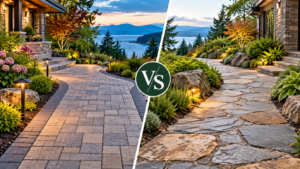
For most Victoria BC homeowners, a concrete interlocking paver walkway delivers better long-term value than natural stone because it handles the region’s wet climate more predictably, costs less to install and repair, and offers more design flexibility. Natural stone remains the stronger choice for specific aesthetics and heritage properties where the organic appearance of slate, granite, or flagstone suits the architecture better than manufactured pavers.
Both are professionally installed on the same base system in Victoria BC: compacted road-base gravel, bedding sand, and edge restraints. The surface material is where the two paths diverge, and understanding those differences prevents a costly choice that does not suit your property or climate.
How Victoria BC’s Climate Shapes the Right Walkway Choice
Victoria BC’s coastal Mediterranean climate delivers over 600 millimetres of annual rainfall, a six-month wet season, and mild but present freeze-thaw cycling during winter months. Any outdoor walking surface installed here faces repeated wetting and drying, surface abrasion from debris, and the biological pressure of moss and algae growth that accelerates in humid coastal conditions.
Properties across Greater Victoria also sit on soil profiles that include clay-heavy sections in Saanich and Oak Bay, and sandy or gravelly ground in parts of Langford and Sidney. Ground movement in clay soils is more pronounced, which affects how a rigid versus flexible walkway surface performs over time.
Paver walkways in Victoria BC perform well in these conditions because the interlocking joint system accommodates minor ground movement without cracking. Natural stone installations also perform well when set correctly, but their performance depends more heavily on the specific stone type selected and the skill of the installer. Not all natural stone is equal in moisture absorption, frost resistance, or slip resistance when wet.
What Is a Paver Walkway in Victoria BC?
A paver walkway uses manufactured concrete interlocking pavers, which are individual rectangular or shaped units produced to consistent thickness and dimensional tolerances. The most widely used paver brands in Victoria BC include Unilock, Belgard, and Techo-Bloc, all of which produce units tested to Canadian Standards Association specifications for compressive strength and freeze-thaw resistance.
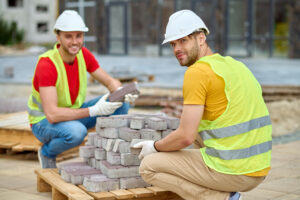
Concrete pavers are installed in a running bond, herringbone, or basket weave pattern over a compacted granular base. Polymeric sand is swept into the joints and activated with water, creating a semi-rigid bond that resists weed growth and joint erosion while allowing minor flexion in the surface. Edge restraints lock the perimeter and prevent lateral spreading over time.
The system is inherently flexible. Because no unit is permanently bonded to its neighbour or to the base layer, individual pavers can be lifted, the base adjusted, and the unit replaced. This makes repair straightforward and cost-effective compared to any rigid surface, including poured concrete and grouted natural stone.
For homeowners considering a paver walkway as part of a larger outdoor project, our guide on walkway installation in Victoria BC covers the full installation process and typical project timelines.
What Is a Natural Stone Walkway in Victoria BC?
A natural stone walkway uses quarried stone in one of several forms. Flagstone refers to flat irregular slabs of sedimentary stone, including bluestone, limestone, sandstone, and slate. Granite and basalt are igneous options that offer very high density and durability. Quartzite provides a crystalline surface with excellent slip resistance when textured.
Natural stone is set either dry, meaning bedded directly in sand without mortar, or wet, meaning mortared into place over a concrete base with grout joints between units. Dry-set natural stone is more forgiving of ground movement, while wet-set installations produce cleaner joint lines but are more vulnerable to cracking if the base shifts.
In Victoria BC, most professional contractors recommend dry-set flagstone for garden and landscape paths, and wet-set granite or basalt for front entry walkways where a refined, formal appearance is the goal. The choice between dry and wet setting is as important as the stone selection itself.
Cost Comparison: Paver Walkway vs Natural Stone in Victoria BC
Cost is one of the most practical factors in the paver versus natural stone comparison, and in Victoria BC the gap is meaningful.
Concrete interlocking paver walkway installation in Victoria BC typically ranges from CAD $20 to $40 per square foot installed, including base preparation, edge restraints, polymeric sand, and labour. A standard 3 foot wide by 20 foot long front entry walkway in pavers costs approximately CAD $1,200 to $2,400 before GST.
Natural stone walkway installation in Victoria BC ranges from CAD $30 to $65 per square foot installed, depending on the stone species, the setting method, and the complexity of the layout. The same 3 by 20 foot walkway in dry-set flagstone runs approximately CAD $1,800 to $3,900 before GST. Wet-set granite with tight mortar joints at the higher end of the stone price range can reach CAD $4,500 to $6,000 for the same footprint.
The cost differential reflects both material cost and labour time. Natural stone requires more careful individual unit placement because each piece is irregular in shape and thickness. Achieving a level, stable surface with dry-set flagstone takes significantly more time per square foot than installing dimensional concrete pavers.
For a full breakdown of walkway and hardscape pricing in Greater Victoria, see our landscaping pricing plans page.
Durability and Lifespan in Victoria’s Wet Climate
Both paver walkways and natural stone walkways deliver long service lives in Victoria BC when installed correctly. The differences lie in how each surface ages and what maintenance or repair looks like over that lifespan.
Concrete interlocking pavers in Victoria BC have a functional lifespan of 25 to 50 years when installed on a properly compacted base. The pavers themselves are highly resistant to moisture and freeze-thaw cycling because they are manufactured to low water absorption specifications. The polymeric joint sand requires replenishment every three to five years as rainfall gradually displaces it.
Natural stone durability depends entirely on the stone species. Dense igneous stones including granite and basalt are extremely durable, with effective lifespans exceeding 50 years under normal residential use. Sedimentary stones including limestone and sandstone are softer and more porous, absorbing moisture that can cause spalling or surface delamination during freeze-thaw cycles. In Victoria BC’s climate, porous sedimentary stone is not recommended for exposed walkway surfaces without sealing.
Slate and quartzite fall between these extremes. Slate offers good durability and natural texture but can delaminate along its natural cleavage planes if flexion occurs in the base. Quartzite is dense, highly durable, and provides excellent wet traction, making it one of the better natural stone choices for Victoria BC.
Drainage Performance: A Critical Factor for Victoria BC
Drainage is where the paver walkway holds its clearest technical advantage over natural stone in Victoria BC. Interlocking paver systems with sand-filled joints allow a portion of rainfall to infiltrate through the joint network into the gravel base beneath, reducing surface runoff.
Permeable pavers, which use wider joints filled with angular aggregate rather than polymeric sand, take this further and meet Capital Regional District stormwater management guidelines for low-impact development. For properties in Victoria BC where drainage is a site-specific concern, permeable paver walkways can serve as both a functional walking surface and a stormwater management tool simultaneously.
Natural stone set on a sand base also allows some infiltration, particularly at the irregular gaps between flagstone units. However, wet-set natural stone on a concrete base is essentially impermeable and requires careful slope design to prevent surface water from pooling.
For properties that have existing drainage challenges, connecting walkway drainage planning to broader landscape drainage is important. Our post on common retaining wall problems in Victoria BC explains how drainage issues affect hardscape structures across a property.
Slip Resistance: Which Is Safer When Wet?
Both paver walkways and natural stone can provide good slip resistance when wet, but the specific product or stone type determines actual performance. This matters in Victoria BC where walking surfaces are wet for six months of the year.
Concrete pavers with a tumbled or brushed finish provide reliable wet traction. Smooth-faced pavers and polished natural stone surfaces are significantly more slippery when wet and are not appropriate for outdoor walkways in a climate as wet as Victoria BC’s.
Natural stone with a riven or split-face surface, including riven slate, split granite, and textured quartzite, provides excellent grip when wet. These textures are produced by the natural fracture characteristics of the stone rather than manufacturing processes, which is why stone selected specifically for outdoor use in wet climates carries different surface specifications than stone used for interior floors.
When comparing products with our team, slip resistance is one of the first factors we assess relative to your property’s specific use and the walkway’s location on the site.
Design and Aesthetic Considerations for Victoria BC Properties
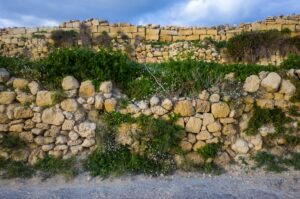
The aesthetic argument for natural stone is straightforward. No manufactured product exactly replicates the colour variation, surface texture, and organic irregularity of quarried stone. For heritage character homes in Fairfield, arts and crafts properties in Oak Bay, and garden-focused landscapes in Central Saanich, natural stone pathways create a visual warmth and authenticity that concrete pavers cannot fully match.
Concrete pavers win on design range and consistency. They are available in dozens of colours, textures, and formats, and they can be installed in precise geometric patterns that suit contemporary and minimalist property styles. The uniformity of manufactured pavers allows for cleaner lines, tighter joints, and more predictable large-format layouts than irregular natural stone allows.
For properties that have installed paver patios, using the same paver product for the connecting walkway creates visual continuity across the hardscape. Our guide on paver patios in Victoria BC explains the design and material options in detail.
Maintenance Requirements: What Each Surface Needs in Victoria BC
Paver walkway maintenance in Victoria BC involves sweeping or blowing debris clear of joints, pressure washing on a low setting when moss or algae accumulates, and replenishing polymeric sand in joints every three to five years. Individual units that shift or settle can be lifted and releveled in a targeted repair without disturbing the surrounding surface.
Natural stone maintenance depends on the stone type and setting method. Dry-set flagstone requires the same joint sand attention as pavers. Wet-set mortared stone requires mortar joint inspection annually, with repointing when cracks appear or joints begin to hollow. All natural stone installed outdoors in Victoria BC benefits from periodic sealing, applied every two to four years depending on the stone’s porosity. Sealing reduces moisture absorption, slows moss colonisation, and makes surface cleaning easier.
Both surfaces require moss management in Victoria BC. Moss grows readily on any outdoor horizontal surface in the coastal Pacific Northwest environment. Periodic treatment with iron sulphate or a moss-specific horticultural product keeps moss growth from establishing on joint sand and stone surfaces through the wet season.
For homeowners who want ongoing maintenance handled professionally rather than self-managed, our landscape maintenance services in Victoria BC include hardscape surface care alongside garden and lawn maintenance.
Which Walkway Is Right for Your Victoria BC Property?
Choose a paver walkway in Victoria BC when your priority is cost efficiency, long-term repairability, drainage performance, or design consistency with an existing paver patio or driveway. Pavers are the better technical choice for most standard residential walkway applications in Greater Victoria.
Choose natural stone when your property has a heritage or garden aesthetic that the organic character of quarried stone serves better than manufactured pavers. Select dense stone types including granite, basalt, or quartzite for exposed locations, and reserve softer sedimentary stones for sheltered garden path applications with lower traffic.
For homeowners who are undecided, a site visit and material review with a qualified contractor produces a clearer recommendation based on your specific property, budget, and aesthetic goals. You can view our completed outdoor projects across Victoria BC to see how both paver and stone surfaces perform in real completed installations.
Frequently Asked Questions
Are paver walkways better than natural stone in Victoria BC?
Paver walkways are the better practical choice for most residential applications in Victoria BC because they cost less, repair more easily, drain effectively, and handle the region’s moisture and mild freeze-thaw cycling reliably. Natural stone is the better aesthetic choice for specific property styles where organic texture and colour variation are the priority.
What natural stone works best for walkways in Victoria BC?
Dense igneous stones including granite and basalt perform best in Victoria BC’s wet climate. Quartzite is an excellent option for its hardness and natural slip resistance. Avoid porous sedimentary stones such as limestone and sandstone for exposed outdoor applications in Victoria BC without sealing.
How much does a paver walkway cost in Victoria BC?
Concrete interlocking paver walkway installation in Victoria BC typically ranges from CAD $20 to $40 per square foot installed. A standard 3 by 20 foot front entry walkway costs approximately CAD $1,200 to $2,400 before GST. For full pricing details, see our landscaping pricing plans.
How long does a paver walkway last in Victoria BC?
A professionally installed paver walkway on a correctly compacted base typically lasts 25 to 50 years in Victoria BC. Most long-term performance issues trace back to inadequate base preparation rather than failure of the paver surface itself.
Do natural stone walkways get slippery when wet in Victoria BC?
Smooth and polished natural stone surfaces become very slippery when wet and are not suitable for outdoor walkways in Victoria BC’s wet climate. Stone with a riven, split-face, or naturally textured surface, including split granite, riven slate, and quartzite, provides reliable traction even in heavy rain.
Can I match a new walkway to my existing paver patio in Victoria BC?
Yes. Most major paver manufacturers including Unilock and Belgard maintain consistent product lines across years so that new walkway installations can be matched to existing patio surfaces. A qualified paver walkway contractor in Victoria BC will confirm product availability and current batch colour matching before installation. See our paver patio guide for Victoria BC for more on coordinating hardscape materials.